Colon AiQ Test – Early Colon Cancer Detection

Colon AiQ offers the opportunity for those who need to be screened, but postpone colonoscopy or do not have access to it, to have a first thorough screening using molecular biology techniques to determine if there is a serious reason for an immediate colonoscopy.

It also provides an intermediate screening option for individuals with confirmed colon syndromes or a family history of cancer, where frequent screening is required, as they are in high-risk groups for developing colon cancer.

colonaiq
colonaiq

Colon AiQ Test – Early Colon Cancer Detection

Colon AiQ offers the opportunity for those who need to be screened, but postpone colonoscopy or do not have access to it, to have a first thorough screening using molecular biology techniques to determine if there is a serious reason for an immediate colonoscopy.

It also provides an intermediate screening option for individuals with confirmed colon syndromes or a family history of cancer, where frequent screening is required, as they are in high-risk groups for developing colon cancer.

A screening option for individuals postponing colonoscopy

According to Global Guidelines, all individuals over the age of 45 should undergo preventive screening for colon cancer.

However, there is a significant percentage of people who delay the preventive procedure of colonoscopy, usually due to its invasive nature. Colon AiQ test is the ideal solution to ensure that we do not neglect our preventive colon cancer checkup, helping us stay informed about our risk status.

Colon AiQ is the most accurate, non-invasive test in Europe for colon cancer, based on molecular biology and AI techniques.

Why should I choose the Colon AiQ test?

  • One of the most accurate tests after colonoscopy: Colon AiQ test shows a significantly high sensitivity (accuracy for positive results), meaning it’s truly reliable in indicating when a colonoscopy is urgently needed.

    With a sensitivity of 86% (the ability to correctly identify positive cases) and a specificity of 92% (the ability to correctly identify negative cases), Colon AiQ outperforms traditional stool-based self-tests (FIT) and cancer marker tests (CEA). It is especially effective in detecting precancerous conditions and early-stage colon cancer, offering 57% higher sensitivity than stool self-tests.

  • Can detect polyps and adenomas:  Colon AiQ molecular test is the only test that can detect adenomas and polyps besides colonoscopy. Early and accurate detection of adenomas is crucial for effective management to prevent the potential development of cancer and to ensure regular, targeted follow-up by a gastroenterologist at appropriate intervals.

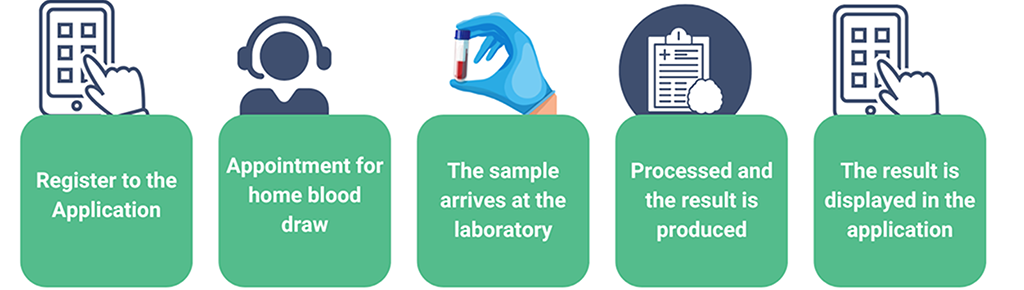
  • Simple, quick, and non-invasive procedure for the examinee: The procedure is simple for the examinee, requiring only a simple blood draw. It is stress-free since no preparation is required. From the moment you order the test, everything is seamlessly arranged. You can even schedule a blood draw at your home or preferred location. Once your prepaid sample is sent for analysis, results will be available within 12-15 working days from the time it reaches the laboratory.

  • Clinical studies confirm its high accuracy:  In one of the largest studies, with over 200,000 participants, presented at ESMO 2024, it was shown that Colon AiQ can detect asymptomatic patients with neoplastic disease who can benefit from early-stage treatments such as endoscopic or surgical removal. See the ESMO 2024 poster.

  • Validated by our scientific partners: IQ Genomix collaborates with a specialized team of molecular scientists who have validated the effectiveness and sensitivity of the Colon AiQ test.

Colon AiQ

The Colon AiQ is an innovative, non-invasive test that utilizes genetic analysis of blood samples to detect specific DNA changes associated with the presence of colon cancer. Thanks to advanced technology for analyzing epigenetic biomarkers in liquid biopsy, Colon AiQ achieves higher sensitivity (accuracy of the positive result 86%) compared to the fecal immunochemical self-tests, especially in early stages of cancer, even at a stage where precancerous lesions (adenomatous polyps) are present.

This supports early colon cancer detection, allowing doctors to implement more effective treatment plans.

Self test (FIT - fecal immunochemical test)

Self test (FIT – fecal immunochemical test) is one of the most common methods for pre-symptomatic screening through the detection of microscopic traces of blood in the stool. However, since it only detects the presence of blood, it may not identify cancerous or precancerous lesions that do not cause bleeding, and the presence of blood could potentially be due to another cause (hemorrhoids).

Additionally, the higher sensitivity of the method seems to be limited to the more advanced stages of the disease, raising concerns about its ability to detect cancer in early stages.
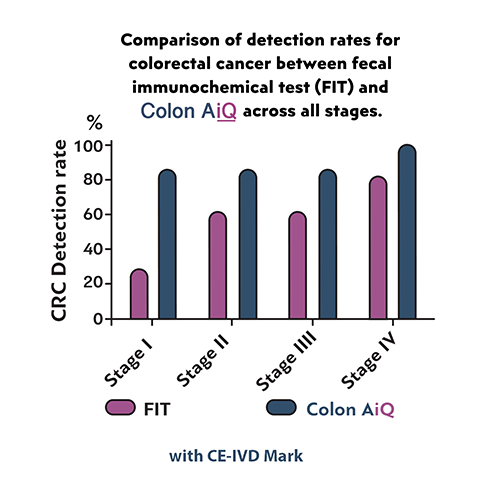
 

The self-test (FIT – fecal immunochemical test) is a method of detecting tiny traces of blood in the stool. However, it only detects the presence of blood.

In contrast, Colon AiQ is an innovative, non-invasive test that uses genetic analysis of blood samples to detect specific changes at the DNA level associated with the presence of colorectal cancer.

Colon AiQ vs. self test (FIT)

Colon AiQ Fecal self-test (FIT)
A molecular test which analyses biomarkers of methylation in blood and is performed in an authorized molecular biology laboratory with experienced scientific staff. Simple detection of blood in stool
Can detect polyps and adenomas in any form Cannot detect polyps and adenomas if there is no bleeding in the intestine
Achieves high sensitivity in early stages of cancer I & II Comparatively shows limited sensitivity in early stages of cancer I & II

Colon AiQ vs. self test (FIT)

Colon AiQ
A molecular test which analyses biomarkers of methylation in blood and is performed in an authorized molecular biology laboratory with experienced scientific staff.
Can detect polyps and adenomas in any form
Achieves high sensitivity in early stages of cancer I & II
Fecal self-test (FIT)
Simple detection of blood in stool
Cannot detect polyps and adenomas if there is no bleeding in the intestine
Comparatively shows limited sensitivity in early stages of cancer I & II

The self-test (FIT – fecal immunochemical test) is a method of detecting tiny traces of blood in the stool. However, it only detects the presence of blood.

In contrast, Colon AiQ is an innovative, non-invasive test that uses genetic analysis of blood samples to detect specific changes at the DNA level associated with the presence of colorectal cancer.

How does Colon AiQ test work?

Colon AiQ is a non-invasive test that is performed on blood (liquid biopsy) and analyzes the methylation profile of 5 clinically validated genetic regions in free circulating genetic material – cfDNA (in the blood).

In the case of colon cancer, the methylation profile of these regions changes. By using this method, we can detect these changes at a very early stage of cancer (even at the stage of advanced adenoma, which is a precancerous lesion) and lead to an early diagnosis through colonoscopy.

Procedure
The Colon AiQ test has 2 possible results

A negative result is reassuring, as it suggests there are no immediate concerns. However, it’s essential to repeat the test annually and remain proactive with ongoing preventive monitoring for colon cancer.

A positive result indicates a significant risk of colon cancer, making it crucial to consult with a gastroenterologist for further evaluation and guidance.

The Colon AiQ test has 2 possible results

A negative result is reassuring and means that we should simply repeat the test next year and generally be typical in our colorectal cancer screening.

If the test shows a positive signal, then there is a serious possibility that cancer has developed in the colon and we should definitely contact our gastroenterologist.

Frequenty Asked Questions

Colon cancer is the third most common cancer worldwide, after breast and lung cancer, and the second most common cause of cancer deaths. However, when detected at an early stage (I & II), it is treatable in approximately 90% of people.

Colon AiQ offers an alternative option for those who avoid colonoscopy or do not have access to it, allowing for an initial thorough molecular check for colorectal cancer. Additionally, it provides the opportunity for intermediate screening between colonoscopies for high-risk individuals, reducing the need for frequent invasive tests.

Yes, the Colon AiQ test can detect adenomatous polyps that develop in the colon lining, which have the potential to develop into cancer if left untreated.

The differences between Colon AiQ and stool self-tests (FIT) are substantial:

Colon AiQ is an innovative, non-invasive test that uses genetic analysis of blood samples to detect specific DNA changes related to the presence of colorectal cancer. Thanks to advanced technology for analyzing epigenetic biomarkers in liquid biopsy, Colon AiQ achieves higher sensitivity compared to the FIT test, especially in the early stages of cancer, even when precancerous lesions (adenomatous polyps) are present. This contributes to early disease detection, enabling doctors to apply more effective treatments.

• In contrast, the stool self-test (FIT – fecal immunochemical test) is one of the most common screening methods, detecting microscopic traces of blood in stool. However, since it only detects the presence of blood, it may fail to identify cancerous or precancerous lesions that do not cause bleeding, and the presence of blood could be due to other causes (hemorrhoids). Additionally, its sensitivity appears to be limited to more advanced stages of the disease, raising concerns about its ability to detect cancer at early stages.

The process is simple:

– Create an account on the ordering platform here.
– A sample collection and transport package is delivered to your address. The package includes a specialized blood collection tube for sample collection by a Healthcare Professional.
– Blood collection is performed by a Healthcare Professional, either through a home appointment (where available) or at a microbiology laboratory of your choice.
– The sample is sent to the specialized laboratory via the partner courier service (ACS), with prepaid shipping included.

Upon receipt of the sample, molecular analysis is performed, and once processing is completed, you will receive a notification to view your results in your account.

Home blood collection (at an additional cost) is available in the following regions:
Attica, Thessaloniki, Achaia, Ioannina, Heraklion, and Larissa.

If you are located outside these regions, blood collection can be performed at a local microbiology laboratory, and the sample can then be sent to our laboratory via the partner courier service, using the prepaid shipping included in the package.

Read the shipping instructions here.

No, a doctor’s prescription is not required to take the Colon AiQ test. However, it is generally recommended to consult with your physician, especially if you receive a positive result.

The Colon AiQ test for colorectal cancer requires 10ml of blood.

No. The Colon AiQ test does not require any special preparation before blood collection.

The results of the Colon AiQ test are provided within 12-15 working days after the sample has been received by IQ Genomix.

To view your results, you will log in with your credentials on the IQ Genomix platform where you have registered.

Payment can be made via IRIS, bank transfer, credit/debit card, in-store payment, or cash on delivery.

If the result is negative, the test should ideally be repeated annually, or at a minimum, every two years if annual testing isn’t feasible.

In the case of a positive test result, you should consult your doctor, as further investigation will be required.

Colon AiQ is a non-invasive molecular blood-based analysis for the detection of specific methylation patterns associated with colorectal cancer.

The Colon AiQ service is performed using CE-IVD certified diagnostic products that comply with European legislation and are legally notified to the Greek National Organization for Medicines (EOF Notification Numbers: 2830001019897, 2830001020671).

Please contact our Customer Service Team at +216 000 5494.